


Subjugation (2 of 2)
«The general position of women in Spain and their influence in public life cannot be described as of an advanced order»
L. Higgin (Spanish life in town and country, 1902)
As the years went by, and well into the 20th century, L. Higgin still noted the limited role that Spanish women played in society. Although his text was written in 1902, very little seems to have changed:
The general position of women in Spain and their influence in public life cannot be described as of an advanced order. Asa rule, they take no leading part in politics, devoting themselves chiefly to charitable works, such as those already named (229).
Thirlmere attempts to add nuance to this assessment by pointing out that there are still gentlemen in Spain. Even so, the author readily assert that Spaniards can never measure up to the English gentleman: “It was agreed that gentleman are to be found in Spain, but that the bourgeoise is not to be compared with the same class in England” (187).
In 1853, Louisa Tenison narrates another episode that highlights the marginalisation of women and the significant degree of misogyny present in the mentality of some groups. The English traveller recounts a curious historical anecdote she heard during her visit to Jerez. When visiting the city, Queen Christina announced her intention of visiting the Cartuja de Jerez monastery, a place where women were never allowed to enter. The monks had to accept the visit but came up with a plan to ensure no trace of the Queen remained: a friar made a chalk mark on every stone or brick that the Queen trod on. After the royal visit concluded, the obnoxious bricks were immediately taken down and substituted. The next day there was no trace whatsoever of a female presence having passed through the place (238).
Reflecting on these changes, we were wandering about unmolested in the courts, where a few short years before the footsteps of a woman spread consternation in the minds of the worthy monks, and perilled both their present and future welfare. No female is ever allowed to enter the precincts of any building dedicated to the disciples of San Bruno. In 1418, this rule was, however, so far relaxed, as to admit of sovereigns and members of reigning families entering them; but the inmates of the Cartuja of Xeres seemed unwilling to admit even of these exceptions, for when Queen Christina happened to be staying in the town, and announced her intention of visiting them, the community were thrown into a state of frightful consternation. One of the monks having bethought himself of a plan by which the convent might be saved from the consequences of the impending calamity, communicated his views to the prior, who at once adopted his suggestion. The Queen arrived, and was escorted over the building, but behind her followed two monks, who watched with careful anxiety every step she took; and on every stone, or brick, on which the sovereign trod, a large white mark was soon impressed. The royal visit concluded, the obnoxious bricks were immediately taken up, and thrown into the Guadalete; others were substituted, and peace of mind was restored to the community (238-239).
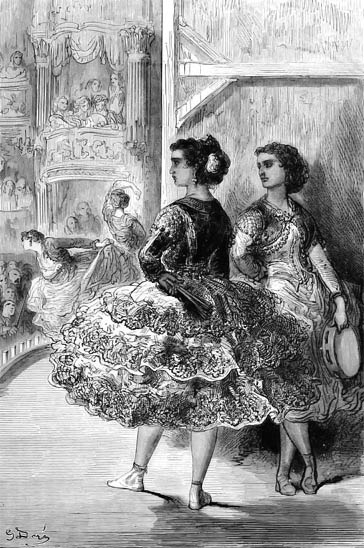
DANCING THE FANDANGO AT THE SAN FERNANDO THEATRE, SEVILLE. L’Espagne, by Baron Charles d’Avillier. Illustration by Gustave Doré.
Various unwritten rules, which foreign female writers struggled to understand, prevent women from participating in many social activities. For example, Ellen Hope-Edwardes comments that she cannot go to a flamenco show because she is a woman. Using a humorous tone, the writer rebels against these norms by having a maid dance for her. Hope-Edwardes also criticises the strict morality of the time, which frowned upon women reading. According to contemporary texts, novels were a male affair, and during her trip she met several girls who confessed they were only allowed to read religious books.
It is also interesting to note how women, and the female body, are used to establish moral standards. For example, in the late 18th century, Philip Thicknesse explains that women can dance the fandango two different ways: in a decent or indecent manner. The anecdote arises when the writer witnesses a performance in a bar called “Salido,” in Barcelona where the woman separates a little from her partner and moves slowly by herself. He says the expression “perra salida” should be used to describe this type of dance (284).
According to several 19th and 20th century texts, going out with no male company was also frowned upon in Spain. However, this restriction, which confined women to the private sphere, was lifted during Holy Week. Hope-Edwardes planned to watch the “madrugá processions in Sevilla,” but was worried about the possible incidents that may arise due to her status as a foreign women and being alone. To her surprise, locals assured her that during the Easter period, women could participate regularly in outdoor life. Therefore, the author was able to attend the processions freely, witnessing first-hand the surprising way in which a traditional religious event helped bring equality between the two sexes.
Two works from 1910 also reveal how little the situation had changed. Firstly, Albert Calvert describes domestic life in the Balearic Islands and mentions that the only acceptable role for Spanish women is housework. When describing the city of Mahon, the author states that the primary occupation of local women is cleaning their houses, an activity they seem happy to do. Secondly, according to Thomas Ewing Moore, women do not socialise with men. In music halls, the audiences are almost entirely composed of men; ladies, except foreign tourists, do not frequent these cafés (146).
Lastly, in 1927, Thomas Ewing Moore spoke of the impeccable morals of Andalusian women and praised their seclusion and subdued role. According to the American writer, women do not swear in public, never go out alone, and are always accompanied by a dueña (governess) who chaperones them (66). Further on, he comments that Spanish women do not go out for a promenade afoot; if they cannot have a carriage, they stop at home, except to go to mass or shop (134).
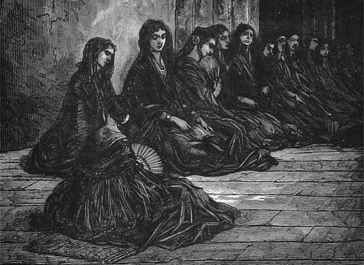
CHURCH OF NUESTRA SEÑORA DEL PILAR, ZARAGOZA (Detail). L’Espagne, by Baron Charles d’Avillier. Illustration by Gustave Doré.


