


Museums and culture (2 of 2)
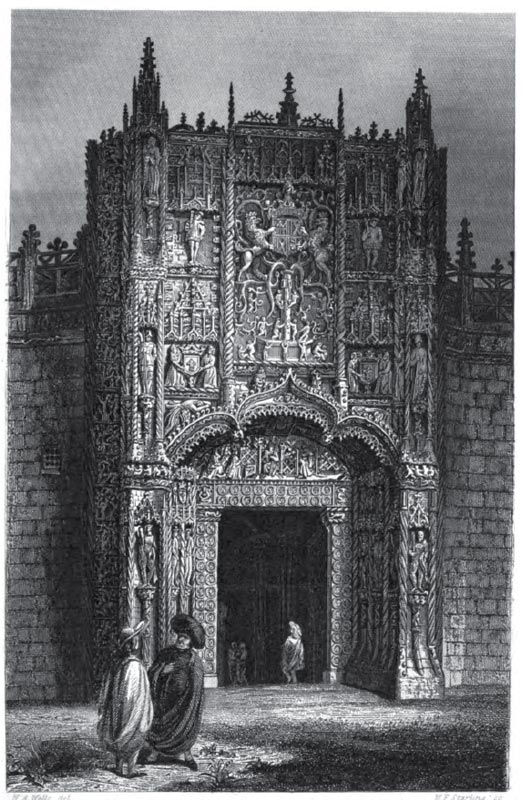
FAÇADE OF SAN GREGORIO, VALLADOLID. The picturesque antiquities of Spain, by Nathaniel Armstrong Wells (1846).
The texts review dozens of other examples of various culture-related institutions. Several writers, including Alexander Mackenzie, mention reading rooms. The American author notes the evolution in the number of reading rooms, supposedly indicative of the increase in the number of readers and, therefore, the level of literacy in the country. Mackenzie also observes that the number of newspapers and other periodicals has increased between his first and second trip, another indication that the Spanish population is showing a greater interest in reading (Vol. I, 171).
Along with the casinos, Richard Ford also mentions reading clubs in his work, providing a list of the best venues in Madrid (A Handbook for Travellers in Spain. Vol. II, 664-665). Furthermore, Alexander Mackenzie details all sorts of similar institutions, such as public libraries, the royal academies of language and surgery, among others, and even schools for the deaf and dumb.
Interestingly, several authors also include references to Spanish theatre and the methods used to stage plays. In 1814, John Blayney goes to the theatre and criticises everything about the experience (284). Half a century later, Julia Byrne claimed that Spanish theatre was indicative of the country’s lack of sophistication. Bryne describes the theatre [in Toledo] like that of a third-rate town in England. She observes that they seem unfamiliar with the idea of stage design on the peninsula, and the props and machinery appear to be very simple (174). Considering that these authors do not understand the language, it is surprising to read these scathing and supposedly objective reviews.
«The stage-arrangements (…) might answer to those of a third-rate country town theatre in England. As for stage-effects, they do not seem to have the remotest idea of any such accessory in the Peninsula, and the properties and machinery seem to be of the very simplest kind»
Julia Byrne (Cosas de España, 1866)


