


Church (2 of 2)
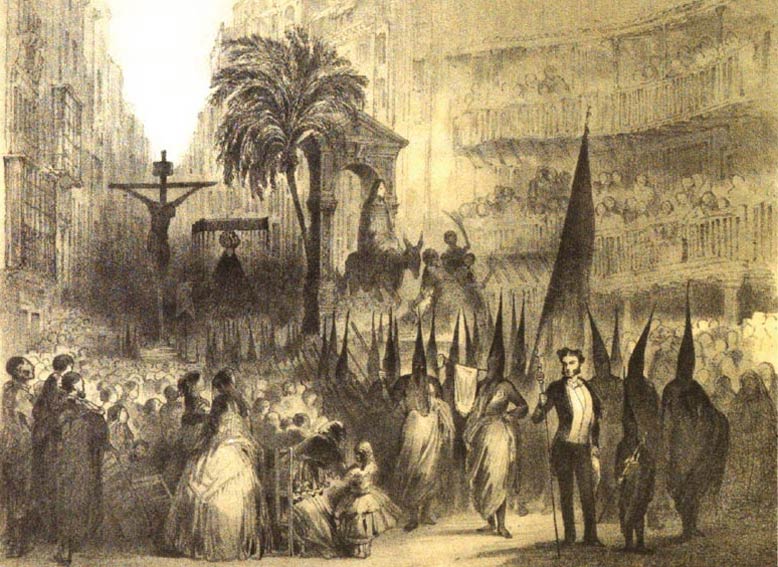
HOLY WEEK PROCESSIONS. Castile and Andalucia, Lady Louisa Tenison (1853).
George Borrow alleges that the Church opposes to liberal thinking. A bookseller who calls himself a liberal converses with the British author and claims to detest the Church, among other things because monks have historically sheltered all sorts of criminals in their churches, although they excluded people with progressive ideologies. The bookseller believes the Church has always exposed and denounced anyone open to such ideas: “In the days of the friars,” said he, “this church was one of refuge, to which if the worst criminals escaped, they were safe. All were protected there save the negros, as they called us liberals” (385).
In 1846, Terence Hughes discusses the financial arrangements of the Church. In the opening pages of the chapter dedicated to the institution, Hughes outlines the collection of funds and argues that the Church has unjustly been neglected by the State due to the declining religious interest in the country. Whilst women, seniors and children keep religious traditions alive, the author observes that men do the exact opposite:
But religion is so deeply rooted in the national character, that the most furious political storms, whicho prostrate everything else, blow over this and leave it unscathed. It is only amongst the educated male population that any lack of fervour is witnessed. When these become absorbed in the maze of politics, all other considerations but intrigue and faction are lost sight of and forgotten; but their mothers, sisters, and daughters, young boys, and old men, have abated little of the fervour of other times, or at least are as determined church-goers as their ancestors (Vol. I, 340).
«The dread of the Inquisition, from whence no secrets were hid, up the Spanish heart, soured the charities of life, prevented frank social communication»
Richard Ford (Manual para viajeros por España, 1845)
The Inquisition is also prominently featured in these accounts. Richard Ford explores the relationship between the Spanish character and this historic institution, suggesting that the Inquisition has profoundly shaped their personality: they tend to be introspective, cautious about speaking out and questioning things. Spaniards are wary of discussion personal matters with strangers:
The effects are, however, the same and this engine of mystery hung the nation like the sword of Damocles; invisible spies, more terrible armed men, omnipresent, omniscient, omnipotent, aimed at every of the Almighty, save his justice mercy. It arrested the circulation life, and man’s heart trembled to the sounds of his own beating. It brooded like a nightmare on the and breath of the nation; hence dwarfed literature, and unsocial isolation. The dread of the Inquisition, from whence no secrets were hid, up the Spanish heart, soured the charities of life, prevented frank social communication, which and improves (Manual para viajeros por España. Vol. I, 207).
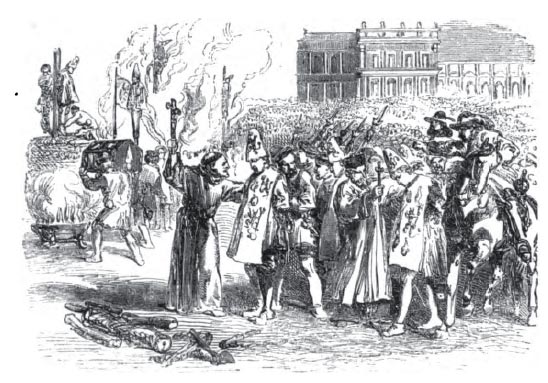
AUTO DE FE. Spanish pictures drawn with pen and pencil, by Samuel Manning (1870).
Writing in 1870, Samuel Manning blames the inquisitorial institution for Spain’s underdevelopment. The author believes the Inquisition crushed out all freedom alike of thought and action (23).
Elizabeth Murray refers to ecclesiastic authorities in a funny anecdote from her journey in 1859. The author used to have breakfast in her hotel with a priest who could not believe that such a cultured woman refused to embrace Catholic faith. The priest was profoundly upset by the idea of Anglican clergymen being allowed to marry and have children. The traveller and the priest were equally surprised when one of the party ventured to remark that if the Spanish clergy were also allowed to marry they might probably have fewer nephews and nieces than they professed to have at present (151-152).
The superstition and ignorance displayed by certain priests is even more surprising than that of ordinary people. A. Andros humorously alludes to this notion when describing the presence of clergy among the passengers travelling from Seville to Cadiz by boat. Amidst rough weather and a turbulent passage, many fall ill and are seasick several times. Some priests attribute these tribulations to the fact that Andros and other “English heretics” were on board (138).
Not all authors criticise the clergy, some also pen favourable assessments of their social work and significant contribution to charity. In the late 19th century, Ellen Hope-Edwardes praises the dedication of nuns to social services and their invaluable work in various Spanish cities, with institutions dedicated to the poor and destitute in Seville, as documented during her visit (169). John Carr also writes positively about the monks he encounters during his travels across the peninsula, some of whom provide him with accommodation. In 1811, Carr commends the hospitality of the monks of San Jerónimo de Baeza, who not only show him around the city but also host supper in the convent (190). The author recalls tasting what he describes as the best wine in Spain, which flowed freely during the evening. A few days later, in Valencia, he is charmed by nuns who he describes as being particularly beautiful and even coquettish (228).


