


Education (2 of 2)
«(…) and learnt that the usual term of study at Salamanca was eight years, that the education embraced Latin, or “grammar,” as it is called, Greek, history and laws; and that two extra years are, by some, devoted to the study of theology, and philosophy, mental and moral»
George Dennis (A summer in Andalucia, 1839)
On the teaching of history, John Armstrong distrusts the official discourse propagated by many historians who, in his view, use their profession to praise the current political regime rather than presenting the true reality of the country (78-79). This stance initiates a dual reflection: history as a form of storytelling and historiography as a discipline that is not immune to bias. In doing so, he foreshadows ideas that would only gain prominence decades later. As early as 1856, the British writer questioned the scientific basis of historical study and doubted its supposed objectivity, which he believed was often compromised to favour the powerful. Amstrong concludes that the history of Spain he is familiar with adheres to partisan interpretations and expresses a willingness to explore alternative perspectives.
In 1836, Alexander Mackenzie claims that university studies in Spain can only be accessed by a minority, available only to aristocratic families and priests. He uses his visit to the building and classrooms of the University of Alcalá to illustrate his opinion (Vol. II, 19). In contrast, at other universities such as those of Salamanca or Valladolid, he observes that the students are generally from more modest backgrounds. Regarding the library, he comments the peculiar organisation of the books, noting that copies of Locke and Robertson are placed alongside works of dubious quality. He also observes that students can only access the library’s collection with special permission, highlighting once again the lack of freedom to access education in Spanish society (Vol. II, 20). Coming from the United States, a country experiencing a period of liberal growth, the writer studies the curriculum and concludes that only humanities subjects are taught, with no emphasis on the sciences. This, he argues, contributes to the country’s industrial backwardness and low economic development (Vol. II, 21-22).
In the early 20th century, travellers wrote about several Spanish universities. Thomas Ewing Moore provides details of the student body and history of the University of Seville in 1927 (66). In the same decade, John Lomas claims that the University of Salamanca has a magnificent library which is at the service of both the professors and the students (34-36).
These travellers are fascinated by the tuna, groups of university students who play and sing traditional instruments and songs, and their relationship with the university. At the inn where he is staying, George Dennis talks to one of these university musicians, learning what subjects are studied at the University of Salamanca and the price of tuition. The student also tells the author that he is a tuno as a hobby, given that he comes from a wealthy family and he does not need to busk:
Here I entered into conversation with him, and learnt that the usual term of study at Salamanca was eight years, that the education embraced Latin, or “grammar,” as it is called, Greek, history and laws; and that two extra years are, by some, devoted to the study of theology, and philosophy, mental and moral. He told me that his father paid for his education fifty dollars per annum, for the first seven years, and two hundred for the eighth, while his companions, who were of a very inferior rank in life, paid but three dollars a year each. I could not refrain from expressing my astonishment, that if his father could pay so much for his education, he should thus roam about like a beggar. “Es todo por divertir a las muchachitas! —it’s all for the sake of diverting the girls!” was his disinterested reply. As for his own diversion, he had enough of that at college. He assured me he was no sopista* for his father held a lucrative post under government, but he preferred rambling about in this gipsy fashion to enjoying the comforts of his paternal abode (Vol. II, 327-328).
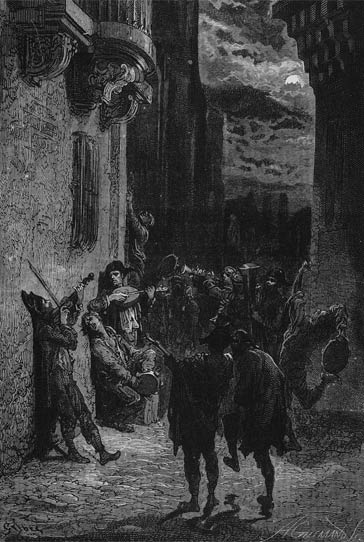
STUDENT SERENADE. L’Espagne, by Baron Charles d’Avillier. Illustration by Gustave Doré.
«As to education, there is something like a government system, by means of which every peasant may learn to read and write; and there are no less than seventeen universities in the kingdom, many of which are open even to the poorest classes»
Alexander Mackenzie (Spain revisited, 1836)
Alexander Mackenzie makes an intriguing observation about public education: he claims that everyone has access to it, with talent being more important than economic status. However, after investigating their backgrounds, he finds that the majority of Spain’s great authors came from noble families (Vol. II. 108-109). Also in the 1830s, George Dennis claims that everyone can learn to read and write thanks to the public education system. Although there are seventeen universities in the country, the system functions poorly due to its reliance on outdated disciplines and methods:
As to education, there is something like a government system, by means of which every peasant may learn to read and write; and there are no less than seventeen universities in the kingdom, many of which are open even to the poorest classes; but in all these seminaries the peripatetic philosophy is still adhered to, in spite of its rejection, ages since, by more enlightened nations— knowledge is doled forth in scanty morsels — freedom of thought is not, or was not till very lately, allowed — and education is thus so stinted and starved by bigotry, as scarcely to deserve the name. Little more than a tolerable knowledge of Latin, with the art of conversation in that tongue, and a love of sophistical disputation, is thus acquired. Can it then be matter of wonder that there is little love of study, little desire of mental improvement in Spain? (Vol. II, 407-408).
When analysing the relationship between the Church and education, Dennis blames the Catholic institution for perpetuating ignorance among Spaniards:
If then ignorance, bigotry, and superstition abound in Spain, if the people have little appetite for knowledge, if they have transferred their affections to baser objects, it is the Roman Church which is to blame. More than this. It is the Church that we must regard as the author, or at least the promoter, of the general dissoluteness of morals (Vol. II, 416-417).
Richard Ford comments on education and the social organisation of students. The English writer is surprised that Spanish students live at home with their parents and not in boarding schools at their universities, as they do in England. The author believes that this is indicative of a healthier family relationship, but explains that it leads to decreased academic performance and less participation in extracurricular activities, especially sports, which hinders their overall development (A Handbook for Travellers in Spain. Vol. II, 517).


