


Administration (2 of 2)
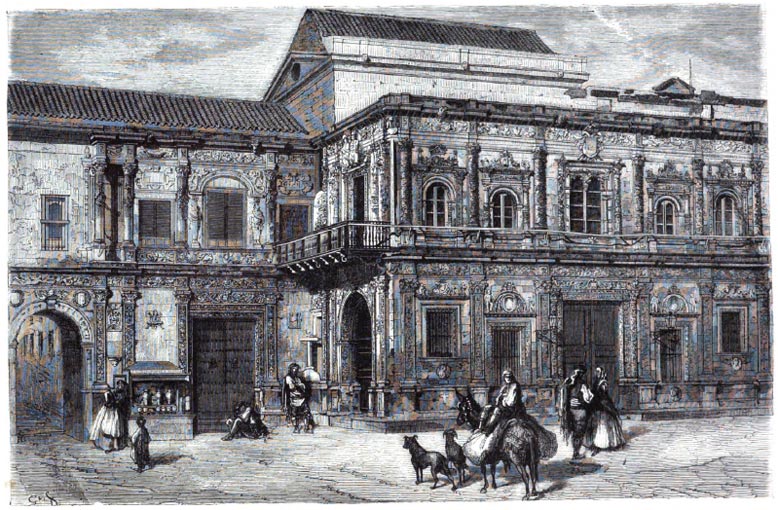
TOWN HALL, SEVILLE. Spanish pictures drawn with pen and pencil, by Samuel Manning (1870). Illustration by Gustave Doré.
According to Emmeline Stuart Wortley, the Spanish endure the challenges of a corrupt administration that has plagued the country throughout its history (328). In her text from 1856, the author is surprised to see the effort of certain people in a nation often stereotyped for its perceived disdain towards work (330). The author identifies many competent, capable, and energetic individuals whom she believes hold the potential to bring about significant positive change (324-328).
Mismanagement in relation to heritage and urban planning is constant. Louisa Tenison claims that the municipal government demolishes marvellous buildings to make tasteless squares. This happened in Seville, for instance, when buildings were knocked down to make room for the Plaza Nueva project, constructed in the mid-19th century (185). Malpractice in artistic heritage is not exclusive to Spaniards, however. According to the English writer, British travellers are also fond of plundering and sometimes steal valuables from the countries they visit. The author ends up justifying the isolated actions of some individuals, arguing that these acts stem from a broader disregard for the true value of antiquities in this country (176).
Louisa Tenison also condemns the situation in palaces and historical sites. According to Tenison, the gardens of the Alhambra are neglected and Spaniards do not care for their natural environment because they do not have adequate knowledge of horticulture. Her reasoning concludes that these gardens are beautiful merely because of the benign climate and not because of the effort and creativity of the local inhabitants (78).
Another shortcoming attributed to the administration is its slowness and lack of commitment to meeting deadlines. During her trip in 1853, Tenison remarks that in Granada, there were plans to construct a major road from the capital to the port of Motril, a project that started ambitiously but was ultimately abandoned unfinished (125). The author also mocks the announcement of a railway line that many doubt will ever come to fruition (125).
On other occasions it is the travellers themselves who cause strange situations. Bart Kennedy arrives at the Calatayud customs office in the early 20th century and decides not to enter the city because he realises he forgot to remove a box of bullets from his rucksack. To avoid getting into trouble, he decides not to visit the beautiful town of Zaragoza (224).
«Too lazy for commerce, too proud to be tradesmen, the hulk of the educated or partially educated classes will sell their souls for places under the Government»
T. M. Hughes (Revelations of Spain in 1845, 1845)
One of the most notorious and disastrous experiences with the administration is that of well-known author, George Borrow, who travelled to Spain to teach the Bible and publish the text in the vernacular. The problems started when he began the process: requesting endless permits, multiple licenses from various authorities, and meeting with political and ecclesiastical officials who responded in a contradictory and evasive manner. After navigating through numerous formalities, he eventually decided to approach the minister, Juan Álvarez Mendizábal, directly. He obtained a letter of recommendation from the British ambassador and then an interview with the minister. Just when he thought he had succeeded, political disturbances occurred and brought everything to a halt. Once the transition from the old to the new government had taken place, Borrow once again tried to approach the new minister, Antonio Alcalá Galiano, with the prior authorisation of the Duke of Rivas for a favourable recommendation. After completing the long process, he was informed that he would not be able to publish the Bible as he also needed the permission of the Church. All of this leads to the author having to return to England for a period of time to ask the Bible Society what he should do (208). The author shows his despair with this lengthy, tortuous and absurd process. His conclusion is clear: the Spanish administration is outdated and poorly organised (164-167).
Another of the shortcomings of the administration is called “empleomanía” (employmentmania). Richard Ford defines it as the obsession of Spaniards to secure positions in public office and remain entrenched in those roles until retirement. According to his account written in the 1840s, this is a trait of Eastern origin fuelled by a hunger for power and a lack of enterprising character (A Handbook for Travellers in Spain. Vol. II, 726). Ellen Hope-Edwardes was also surprised in 1883 that the dream of all Spaniards was to be a civil servant (Vol. I, 157). In mid-19th century, Terence Hughes presents “employmentmania” as one of the great problems of the country. According to the Irish writer, indolence and a lack of entrepreneurial spirit meant that many people wanted to be civil servants:
The most fatal taint in the political and social state of modern Spain is what is emphatically termed Empleomania, or the rage for place. Too lazy for commerce, too proud to be tradesmen, the hulk of the educated or partially educated classes will sell their souls for places under the Government (123).


