


Violent (2 of 2)
Spanish women have also inherited this violent streak, according to many authors. Terence Hughes recounts with humour and irony how most working class women hide a knife somewhere on their bodies, usually in their garter belts. The knife is, along with the rosary, a fundamental part of women’s attire:
The Andaluza is absorbing, merciless. Except amongst the higher classes, many women are as regularly provided with a knife as a rosario, and prepared to stab (if needful) as well as pray. The knives of the men here are of a peculiar make. When shut they are of great length, and open they are like a sabre. The name of this weapon is navaja; and the aim, when used, is invariably to rip up the entrails. I have already described Jacinta’s cuchillo, which was worn in a peculiar manner. The Triana women and lower classes of Sevillians carry their knives, for the most part, like the Manolas of Madrid (p. 404).
This hot-headed nature sometimes leads to violence towards animals. Many authors bear witness to merciless situations, noting that the coachmen often mistreat the horses. For example, Emmeline Stuart-Wortley denounces cruelty to animals, and not only in her highly critical description of bullfighting. According to the author, poor caged crickets, birds or crabs on the beaches of Cadiz are subjected to horrific situations, being dismembered and then returned alive, in the hope that the claws will grow back before they are subjected once again to the same cruel ritual:
A kind of small crab is produced in these marshes in vast numbers, the fore-claws of which are considered great dainties by Epicurean Andalusians; these crabs are called cangrejos. The way, however, in which these favourite delicacies are procured is revoltingly cruel, for actually these fore-claws are taken from the poor little animals while alive, and after this the wretched creatures are thrown back again into the marsh, that the claws may sprout again, and furnish fresh dainties to the Cadiz lovers of shell-fish, and gourmands, (the Andalucian ichthyophiles, as Ford calls the,), and fresh horrors of dismemberment to the poor little crab. Where, but in a bull-fighting nation, could such deliberate cold-blooded vivisection be allowed? These unfortunates and the salt heaps, the “salinas” seem pretty nearly the only “lions” of “Leon”, the “Isla” (85-86).
«The Andaluza is absorbing, merciless. Except amongst the higher classes, many women are as regularly provided with a knife as a rosario, and prepared to stab (if needful) as well as pray»
Terence Hughes (Revelations of Spain in 1845, 1845)
Alexander Mackenzie sees the muleteer driving them from Salamanca to Tordesillas punishing an animal for eating another mule’s food. The muleteer takes his anger out on the animal and does not let it rest the whole way. Mackenzie concludes that Spaniards always take punishment, revenge and resentment to the utmost extreme (137-138).
In contrast to the violence highlighted by these authors, in Travels in the South of Spain William Jacob indicates that, in Spain, charm lies in the moderation of passion:
To call a man a liar, or even to take him by the nose, would not here produce a duel, nor perhaps be thought of the next day; the point of honour is not observed, and there is in consequence none of that delicate sensibility which characterizes gentlemen in England. (…) but when all the circumstances of society are considered, it is probable that more benefit than evil may have arisen from the practice. We owe to it in England much of that gentlemanly feeling which neither gives, nor will receive an insult, and that regulation of the passions and temper which, next to intellect, is the best charm of good society (171).
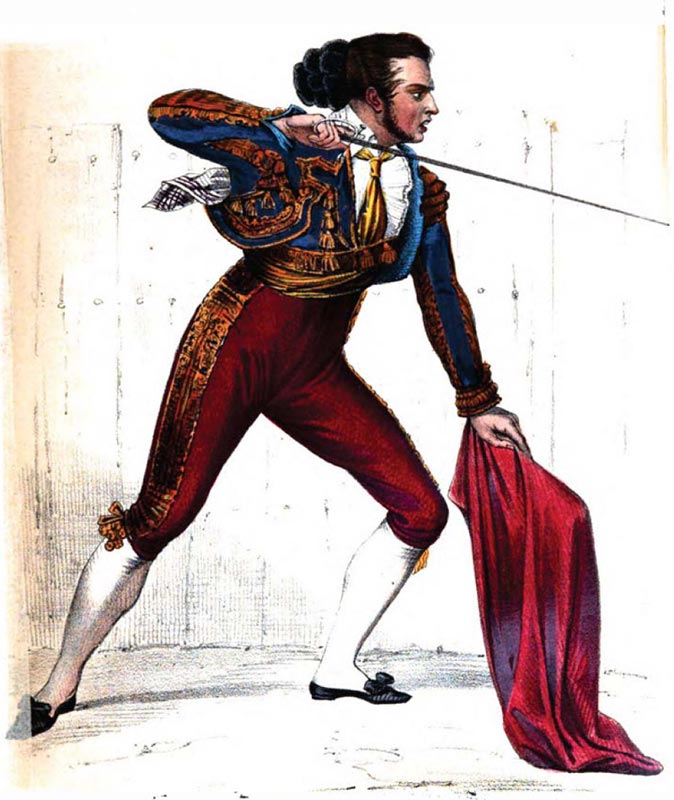
MONTES, THE FAMOUS MATADOR. The Rhone, the Darro and the Guadalquivir: a summer ramble in 1842, by Mrs. Romer (1843).
Geographical determinism is a common strategy employed by many authors seeking to explain the behaviour of a particular human group, by associating their character with the landscape that surrounds them. In this case, the environment serves as a metaphor for the harsh and violent character of the Spaniards, which is conditioned by living on land that is equally inhospitable and aggressive. Richard Ford, for instance, draws parallels between the character of the inhabitants of Corcubión and their landscape. Similarly, Borrow uses the rugged Spanish coast as a metaphor for the character of its inhabitants. In the chapter devoted to Galicia, the rugged and wild coastline of the northwest of the peninsula is compared with the behaviour of its people. For Borrow, the Galician coast serves as the visitor’s introduction to Spain, representing the stern and indomitable character they will encounter throughout their travels.
There is an air of stern and savage grandeur in everything around, which strongly captivates the imagination This savage coast is the first glimpse of Spain which the voyager from the north catches, or he who has ploughed his way across the wide Atlantic: and well does it seem to realize all his visions of this strange land. “Yes,” he exclaims, “this is indeed Spain — stern, flinty Spain — land emblematic of those spirits to which she has given birth (…)
Yes, yonder is indeed Spain; flinty, indomitable Spain; land emblematic of its sons!” (429).


