


Lazy (2 of 2)
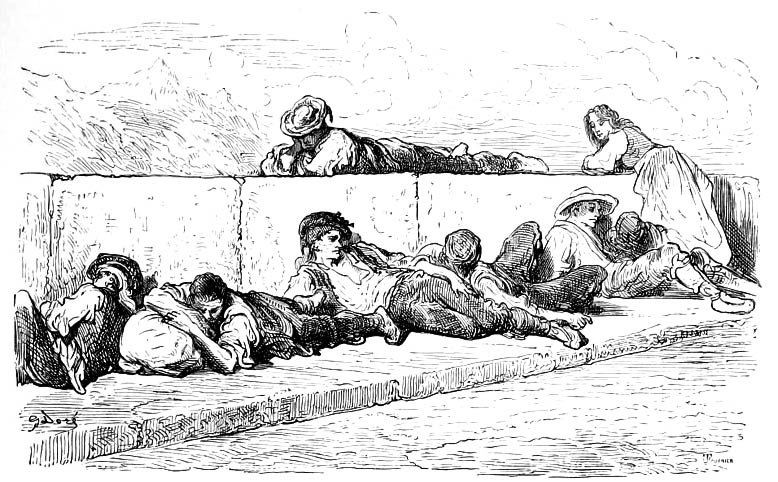
BYSTANDERS ON THE BRIDGE IN ALICANTE. L’Espagne, by Baron Charles d’Avillier. Illustration by Gustave Doré.
Henry Blackburn describes people-watching as laziness. In Travelling in Spain, he and his companions travel by stagecoach to Madrid and, after describing the dirty interior of the vehicle, he turns his attention to a group of layabouts watching their arrival expectantly (215). In a very similar way, in the first volume of his book, Arthur Brooke notices people relaxing in the street or simply observing others and is quick to qualify them as lazy and indolent. The same can be observed in a description of Madrid, noting that in its wide streets and squares, inhabitants flaunt their lethargy and idleness (294-295). Andrew Thomas Blayney also refers to the locals’ laziness, which he seems to associate with a genetic trait, revealing the xenophobic principles of the essentialist discourses of the time:
Old Castille has several considerable towns, but the present state of uncertainty (as to who shall eventually remain master of the country), as well as the natural indolence of the Spaniards, paralyzes all industry (382).
In addition, Arthur Brooke states that aside from being lazy, Spaniards are conformist (94-95). Occasionally there is room for sarcasm, as in Thomas Roscoe’s description of a fire in Madrid. He asserts that everything moves as a sluggish pace in Spain, except for flames:
We quickly discovered that there were no fire engines. In fact, such contrivances as these, belong to a people farther advanced in activity, and must therefore be discouraged where the spirit of the good old times is to be kept up. This seemed greatly to the satisfaction and convenience of the flames, — the only things in Spain that are not lazy (166).
However, some writers do contradict the stereotypes perpetuated in earlier guide books by introducing what could be called “anti-clichés.” For instance, Arthur Brooke is taken by surprise upon seeing workers in the fields in Andalusia, with labourers toiling away on gravity-defying mountain slopes where it seems impossible for them to stand upright. The traveller affirms that the view denoted more activity and perseverance than he could have imagined in a Spaniard (Vol. I, 173).
Hard-working and productive are some of the adjectives used repeatedly by John Carr in his description of the Spaniards in many regions (134 and 199). Samuel Widdrington also speaks out against the cliché of Spain as a lazy nation, offering detailed descriptions of the work ethics of the Spaniards, including the peasants of the Basque Country:
These people were working extremely hard, with the greatest hilarity and cheerfulness, romping and laughing as they carried on the various occupations they were engaged in, but without the smallest intermission to their exertions (Vol. II. 126).
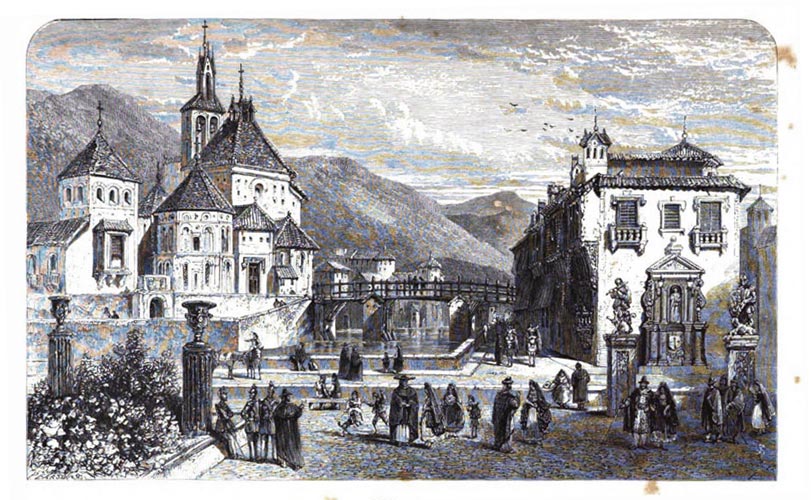
MALAGA. Impressions of Spain in 1866, by Lady Herbert (1867).


