


Welcoming (2 of 2)
Henry Blackburn also highlights the Spaniards’ welcoming character and notes the tradition of socialising in courtyards in his book Travelling in Spain. Thanks to the letters of introduction they brought with them, the writer and his fellow travellers are welcomed into the formidable homes of several aristocratic Sevillian families. Blackburn speaks of deliciously perfumed courtyards filled with the sound of music and dancing, hosting visitors and concerts (160-161). Blackburn and his entourage admire the comforts and luxury in which the aristocracy and, in some more modest cases, the local middle class live, and lament the fact that many of their compatriots pass through the city unaware of this affable aspect of Spanish culture.
In addition to the permeability between public and private spaces, many travellers marvel at another Spanish tradition that also influences their gatherings: the brasero (brazier). At first these authors are surprised by its oddity, but later appreciate how it helps them integrate into the friendly environment. Assembling the family around an element that provides warmth is the perfect excuse to create an atmosphere that encourages an exchange of views. Travellers point out how Spaniards use this setting to talk about their concerns and share their experiences, worries and desires, problems and hopes. The brasero as a social meeting place sparks curiosity among the writers, and at the same time leaves lasting memories. Many of these authors write about the brasero, noting how different the experience is compared to the solemn large fireplaces constructed in the houses of their countries of origin. A good example is Louisa Tenison’s text, Castile and Andalucia, which includes a very extensive fragment describing the brasero accompanied by a translation of an essay on the same element by Spanish writer Ramón Mesonero Romanos.
Expressions of affection among Spaniards resonate in the writings of all these authors. Likewise, nearly all travellers passing through Spain praise the lively ambiance of the streets and the sociable nature of the inhabitants. The social and commercial vibrance, or the absence of the latter, in Spanish public places serves as a common thread in texts linking urbanism and the character of the citizens. George Dennis also mentions how Spaniards offer up their homes to foreigners (222). Similarly, George Borrow describes this same characteristic in The Bible in Spain:
I experienced much grave kindness and simple hospitality from the good people of Villa Seca during my sojourn amongst them. I had at this time so won their hearts by the "formality" of my behaviour and language, that I firmly believe they would have resisted to the knife any attempt which might have been made to arrest or otherwise maltreat me (423).
As an exception to the rule and despite the widely praised hospitality of the Spaniards, some authors depict instances of aggression towards outsiders. George Dennis recalls children throwing stones at him while he was drawing. The British explorer does not give the event much importance: it is the first time he is mistreated by the locals, so he concludes that it is unusual among Spaniards (Vol. II, p. 212).
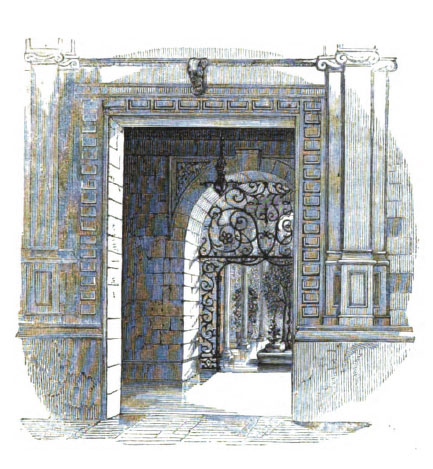
COURTYARD IN SEVILLE. Cosas de España: illustrative of Spain and the Spaniards as they are, by Wm. Pitt Byrne (1866).


