Others (2 of 2)
«The Spanish smuggler, so far from feeling himself to be a criminal or degraded, enjoys in his country the brilliant reputation which attends daring personal adventure, among a people proud of individual prowess»
R. Ford (A Handbook for Travellers in Spain, 1845)
The figure of the smuggler appears in many texts. Alexander Mackenzie comments that one of his companions when travelling to Zaragoza, a tailor, imports materials from France through a smuggling network. He recounts his experiences with them and how these individuals betrayed him on many occasions (105). Smuggling is, according to Ford, the best structured and organised business, thriving in a country with little focus on trade. Moreover, it is a growing activity fuelled by corrupt officials and absurd laws. The smuggler is described almost as a hero, a figure admired by everyone in Spain:
The Spanish smuggler, so far from feeling himself to be a criminal or degraded, enjoys in his country the brilliant reputation which attends daring personal adventure, among a people proud of individual prowess. He is the model of the popular sculptor and artist—the hero of the stage, its Macheath: he comes on dressed out in full Majo costume, with his retajo or blunderbuss in his hand and sings the well-known Seguidilla: “Yo que soy contrabandista, yo ho!” to the delight of the old and young, from the Straits to the Bidasoa, tide-waiters not excepted. In his real character he is welcome in every village; he brings sugar and gossip for the curate, money and cigars for the attorney, ribbons and cottons for the women (252-253).
The Moors are also cited on several occasions when referring to settlers who inhabited the peninsula during the al-Andalus period. George Borrow, for example, praises their participation in peninsular culture and acknowledges their contribution to contemporary Spain, which he finds both exotic and oriental (224). Several authors are surprised that this legacy has not been more fully recognised. This subject is discussed at greater length in the “Orientalism” section of the CLICHÉS chapter.
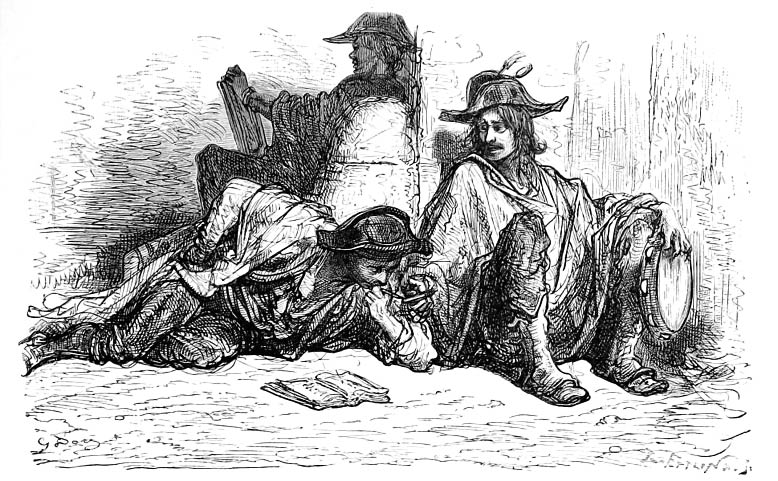
The student as an archetype also appears in many texts. Alexander Mackenzie speaks of the students who arrive in Madrid from Valladolid or Salamanca without money and resort to mendicity to procure funds for the dance during the carnival celebrations. These students play music in exchange for alms. The American author is probably describing groups of tunos (part of student music groups), who he greatly admires for their costumes and harmonious singing (250).
Interestingly, these texts fail to mention the archetype of the drunkard, a character commonly found in travel accounts from other countries. Only a few isolated instances of soldiers drinking in groups are mentioned briefly in passing. This could be due to something that travellers themselves have noted: the cultural relationship with wine in Spain and the restraint of citizens when drinking. There are few examples of people being described as intoxicated by alcohol. Many authors allude to this, including George Ticknor and Rose Macaulay. The latter states that Spaniards do not overindulge in alcohol, and that the only drunks she encountered in the whole country were a group of English compatriots (138).
STUDENT MUSICIANS FROM LA TUNA. L’Espagne, by Baron Charles d’Avillier. Illustration by Gustave Doré.