


Beggars (3 of 3)
«Such bundles of rags, such a mass of dirt and poverty! They were the very picture of distress!»
Louisa Tenison (Castile and Andalucia, 1853)
Stuart Wortley ironically comments on beggars and the way they thank God and all the saints, instead of thanking the person giving them alms (319). According to Ellen Hope-Edwardes, there are “official beggars” in Spain. Beggars are authorised in the country, she posits, and says that in several places they have seen them wearing badges, identifying them as being beggars from the town they are in. These English-speaking travellers are surprised by the Spanish attitude of recognising begging as a possible human condition (123).
For other authors such as Ellen Hope-Edwardes, the poor are merely models for Murillo and other painters, yet another example of picturesqueness (175). Ellen Hope-Edwardes chronicles an encounter with beggars based on the use of the mantilla shawl, or rather the absence thereof in the author’s case. Hope-Edwardes is wearing a hat and is identified as a foreigner from afar, with beggars calling out “Sombrero!” (hat) and surrounding her in large numbers. The author confesses that she is thinking of adopting a mantilla because some churches will not admit women without one, but mainly to avoid the beggars (43).
Ellen Hope-Edwardes is among the authors who are particularly vexed by the persistent solicitation of people who turned poverty into a profession. Albeit surprised by the kindness and respect that Spaniards show towards this disadvantaged group (157), she acknowledges that their overwhelming presence annoys her —even at the entrance and exit of bullfights, for example. She is also critical of their professionalism, mentioning that they have picked up a few words in foreign languages to address tourists: they say “sammani” instead of “some money” (235). What bothers her is their lack of shame in asking. This reflects the ongoing debate between the contrasting views of the work ethic of Protestant Northern Europe and the more lenient attitude of Catholic Mediterranean countries towards begging.
Susan Hale remarks that Spanish beggars maintain their composure and appear decorous, claiming that they wear their cloaks as if they were noblemen. This observation ties in with another recurring theme: the importance of appearances and judgements (36). Against this view, towards the late 19th century, writer Mrs. W. Tolemache argues that the culture of begging should cause a feeling of shame.
Louisa Tenison humorously describes several characters as the genuine embodiment of destitution:
On the side of the cathedral, opposite to the cloisters, stands the bishop’s palace, and although I have witnessed many scenes of wretchedness and misery, I never saw such beggars as came out of that palace early one morning, when we happened to be passing. Such bundles of rags, such a mass of dirt and poverty! They were the very picture of distress! (Vol. II, 409).
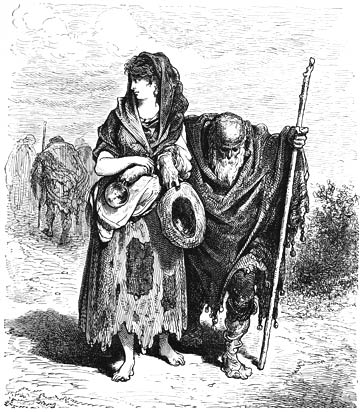
AN ELDERLY MENDICANT AND HIS GRANDDAUGHTER. L’Espagne, by Baron Charles d’Avillier. Illustration by Gustave Doré.
«We met tramps who were thoughtful enough of the future to carry a heavy ragged blanket over their shoulders to protect them from the cold night blasts and a small earthen pot for cooking food that might be given to them»
Edward Penfield (Spanish sketches, 1911)
In the early 20th century, Bart Kennedy finds satisfaction in the presence of beggars because he says they keep the city awake. Beggars embody persistence and tenacity while the city sleeps (100). His opinion of these characters is radically opposed to that of many earlier travellers. While the latter felt overwhelmed and considered them a plague, Kennedy believes that Spain has managed to design a social system that protects this marginalised group. In his home country, being a beggar is tantamount to being a criminal. Whilst in Spain, beggars enjoy as much freedom of movement as rich men. Travelling from Madrid to Zaragoza, the author remarks that he observed how a group of beggars lived, an experience that tourists do not usually share with their readers. He was surprised to see that they had enough to eat, enjoyed life more and did not have to endure the paradox of working themselves to the bone just to survive (254-256).
By the 1920s, the number of beggars seems to have shrunk greatly, or at least authors do not complain so much about their presence. Travelling in 1927, Thomas Ewing Moore notices that there are only a few beggars at the door of Seville Cathedral. Interestingly, the paupers described by Edward Penfield in 1910 do not actively beg, despite their apparent destitution. They are reserved yet helpful, never asking for money and only accepting what is offered voluntarily.
They answered our questions, but did not ask for money. We met tramps who were thoughtful enough of the future to carry a heavy ragged blanket over their shoulders to protect them from the cold night blasts and a small earthen pot for cooking food that might be given to them. Cigarettes were always received with great pleasure; but they were fain to talk (38-41).
In 1910, Thomas Moore is surprised to see the number of beggars decreasing, given that Spanish people are prone to giving alms, unlike the inhabitants of his native USA. Finally, in the 1920s, Allison Peers comments that there are child beggars who besiege visitors, wherever they may go. She compares them to professional beggars, saying that the latter are more tolerable because they at least limit their field of operation to church entrances (97). She calls the young beggars street urchins and rascals, and comments that not all of them are gypsies.


