


Gypsies (2 of 2)
«I never met with anything to make me repent of my confidence; I found the gipsies always civil and obliging»
Elizabeth Murray (The cities and wilds of Andalucia, 1853)
At times, the struggles of this group, including their difficulties in finding work and being regarded as honest, become apparent. Borrow encounters a gypsy woman and her son in Toledo and recounts their story:
At Toledo I met with a forlorn gypsy woman and her son, a lad of about fourteen years of age; she was not a native of the place, but had come from La Mancha, her husband having been cast into the prison of Toledo on a charge of mule-stealing: the crime had been proved against him, and in a few days he was to depart for Malaga, with the chain of galley-slaves. He was quite destitute of money, and his wife was now in Toledo, earning a few cuartos by telling fortunes about the streets, to support him in prison She told me that it was her intention to follow him to Malaga, where she hoped to be able to effect his escape. What an instance of conjugal affection! and yet the affection here was all on one side as is too frequently the case. Her husband was a worthless scoundrel, who had previously abandoned her and betaken himself to Madrid, where he had long lived in concubinage with the notorious she-thug Aurora, at whose instigation he had committed the robbery for which he was now held in durance (515).
After learning about the case in detail, Borrow realises that her attempt to help her husband escape, which he initially thought was a product of her love, was in fact a rule established by gypsy law: the wife is obligated to do whatever is necessary for her husband, even if he has betrayed her many times before.
Samuel Widdrington again compares gypsy culture with the Indian and Oriental societies, delivering a puritanical analysis of gypsy dances where enjoyment of the sensual and voluptuous aspects coexists with their censorship:
The dancing was a good deal in the oriental style, and more remarkable for the activity and the contortions the girls gave to their supple forms, than for any grace displayed on the occasion. Many of their movements, indeed the greater part, were extremely voluptuous, but their figures were too slight and defective in development, to give much effect to them. (…) They were as genuine specimens of the race as it was possible to behold, and the Indian or Asiatic origin was very strongly pourtrayed in their physiognomies (359-360).
Some authors challenge many of the most widespread clichés about this group: Elizabeth Murray states that gypsies have bad reputations, not bad intentions. Among other examples, she recounts how everyone warned her not to go to the neighbourhood of Triana because of the supposedly dangerous nature of its inhabitants. Even so, she ventures ahead and meets reliable, sincere and affectionate people:
However, I never met with anything to make me repent of my confidence; I found the gipsies always civil and obliging; my pencil was constantly employed in transferring the features of those whose appearance struck me, to my sketch-book; and when the work was done, we always parted good friends (200-201).
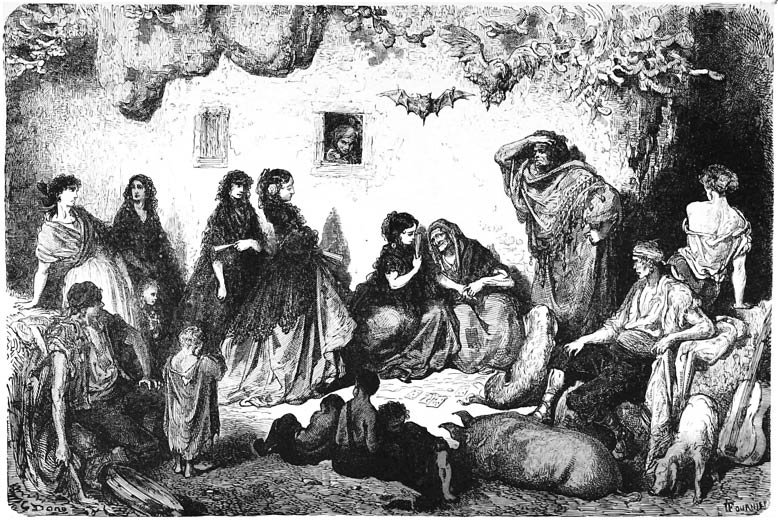
AN ADVENTURE IN SACROMONTE. L’Espagne, by Baron Charles d’Avillier. Illustration by Gustave Doré.
In the early 20th century, Bart Kennedy also provided a positive description of the gypsies. The author was fascinated by the gypsy custom of living in caves, viewing it as a return to nature and a natural environment. He was further captivated by the mystical quality of the gypsy way of life, which infuses spirituality into even the most mundane and physical things, such as dances. Kennedy also describes the performance of a beautiful gypsy woman, Lola, who dances in one of the caves with a rhythm that expresses “all the beauty and all the mysteries of the body” (107-109).
Bart Kennedy’s reflection on gypsies goes further than that of other travellers, extending beyond the usual criticism. The English writer challenges racist descriptions of the gypsy people associating them with criminality and delinquency, as was common at the time. When he visited the villages of Guadalajara, he met some gypsies and requested a woman’s palm-reading services, which allowed him to observe them closely. The author was struck by the aura of mystery surrounding their practices and the solemnity maintained as the gypsy woman told his future. Although he was unable to grasp much of the reading, he noticed that the gypsies were equally captivated by his presence, and concluded that palmistry was not only a way to earn a few coins, but also allowed them to gauge the attitude of outsiders towards their community (209-210).
However, most of these authors maintain a certain distance and consider the gypsy population as a backdrop, often without delving deeper into their social issues and culture. Furthermore, authors are frequently drawn by the community’s supposed marginality, fascinated by its exoticism and picturesqueness. Thomas Ewing Moore describes them as a dirty and ragged motley crew and says gypsies are worthy of being painted. The author states that “these outcasts make a well-dressed crowd” in Rotten Row, a slum located right next to the opulent Fifth Avenue in New York (134-135).
Negative opinions of the gypsy population persist well into the 20th century. Allison Peers describes them in pejorative terms, focusing particularly on their dishonesty. Peers recounts several episodes to illustrate this idea: they sell castanets at double the price, and demand money for a photo or a flower after harassing visitors (95).
Other authors direct their derogatory opinions about gypsies towards Spaniards themselves, criticising how they perpetuate these negative views of gypsies around the world. In 1938, Gertrude Bone questions why Spaniards are bothered by foreigners enjoying gypsy dancing. The author claims that this reaction denotes a certain disdain towards a group that has successfully derived economic benefits from their lifestyle and traditions (37).


