

Siglo XX El multilingüismo en la Unión Europea
19
Orígenes: un discurso de guerra y paz
El proceso de construcción de lo que hoy conocemos como Unión Europea se inició tras la Segunda Guerra Mundial, el más sangriento de los conflictos que asolaron el continente.
El 9 de mayo de 1950, el ministro francés de Asuntos Exteriores, Robert Schuman, marca con su histórica declaración el inicio de una nueva cooperación europea.

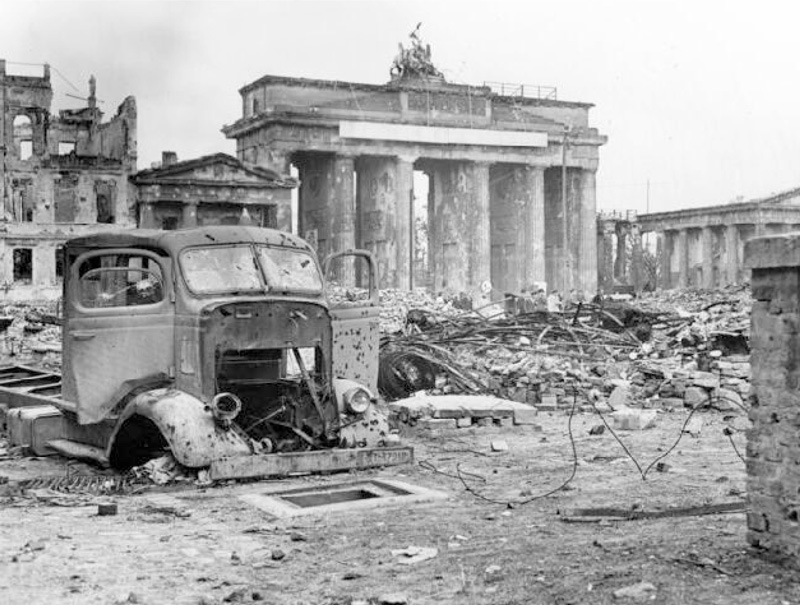
Berlín, 1945. Bundesarchiv, B 145 Bild-P054320 / Weinrother, Carl / CC-BY-SA 3.0.
El 9 de mayo se celebra el Día de Europa.
En los años 50, al inicio del proceso de integración europea, las Comunidades Europeas —precursoras de la actual UE— solo tenían seis Estados miembros y cuatro lenguas (alemán, francés, italiano y neerlandés). Ya entonces, las instituciones europeas de reciente creación necesitaban intérpretes y traductores para garantizar el buen funcionamiento de las reuniones y una comunicación escrita eficaz.
El multilingüismo de las instituciones de la UE es un principio fundamental reconocido por el Reglamento n.º 1/58 del Consejo, que ha ido adaptándose en función de las nuevas incorporaciones de países desde las cuatro lenguas iniciales hasta las 24 actuales.

España se adhirió a las Comunidades Europeas en 1986, junto con Portugal. Desde el 1 de enero de aquel año, el español y el portugués son lenguas oficiales de la UE.
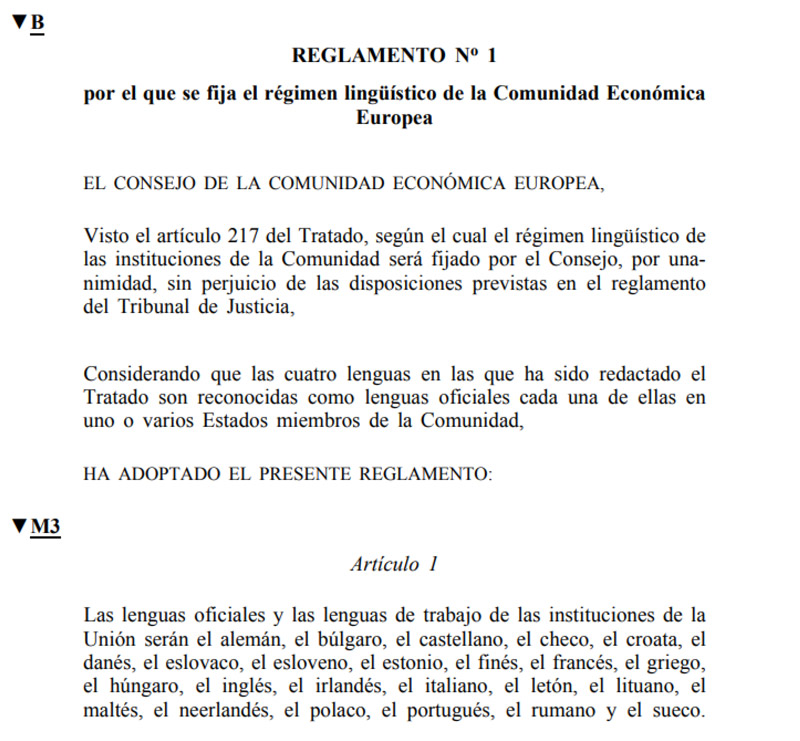
Primera página del Reglamento n.º 1 (DO 6.10.1958), por el que se establece el régimen lingüístico, en su última versión adaptada tras la adhesión de Croacia en 2013.
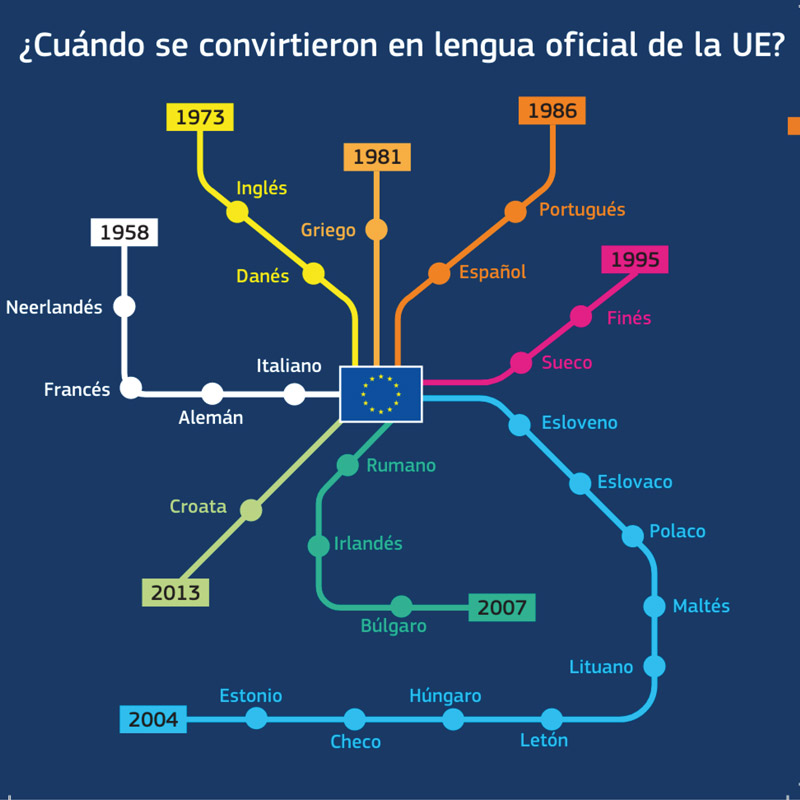
Mapa del metro de las lenguas, de Translation in figures 2022. Publicación de la DGT.
El lema de la UE, «Unida en la diversidad», también ilustra la diversidad lingüística de la Unión. Los traductores y los intérpretes garantizan la comunicación multilingüe y hacen posible que la legislación europea esté disponible en las lenguas de los Estados miembros con idéntico valor jurídico en todas sus versiones.

Primeros pasos
A principios de los años 50, la Alta Autoridad, que más tarde se convertiría en la Comisión Europea, empleaba a unos 35 traductores y revisores, que traducían a las cuatro lenguas oficiales. Los traductores contaban con la ayuda de taquígrafos, que anotaban las traducciones, y de mecanógrafos, que escribían el texto a máquina.
Desde mediados de los 60 hasta principios de los 90, los traductores dictaban sus traducciones en un dictáfono y, a continuación, intervenían los mecanógrafos para pasar la grabación a papel.
Al principio, los intérpretes trabajaban principalmente de forma consecutiva: el intérprete hablaba una vez que el orador había terminado. Sin embargo, la interpretación consecutiva prolongaba considerablemente las reuniones, por lo que la interpretación simultánea, en la que el intérprete escucha y habla al mismo tiempo, se hizo cada vez más habitual.
El proceso de Núremberg de 1945 a 1946 suele considerarse un momento crucial en la historia de la interpretación. La simultánea se había empezado a utilizar casi veinte años antes (véase el panel 17), pero en Núremberg se impuso como modo habitual de trabajo.
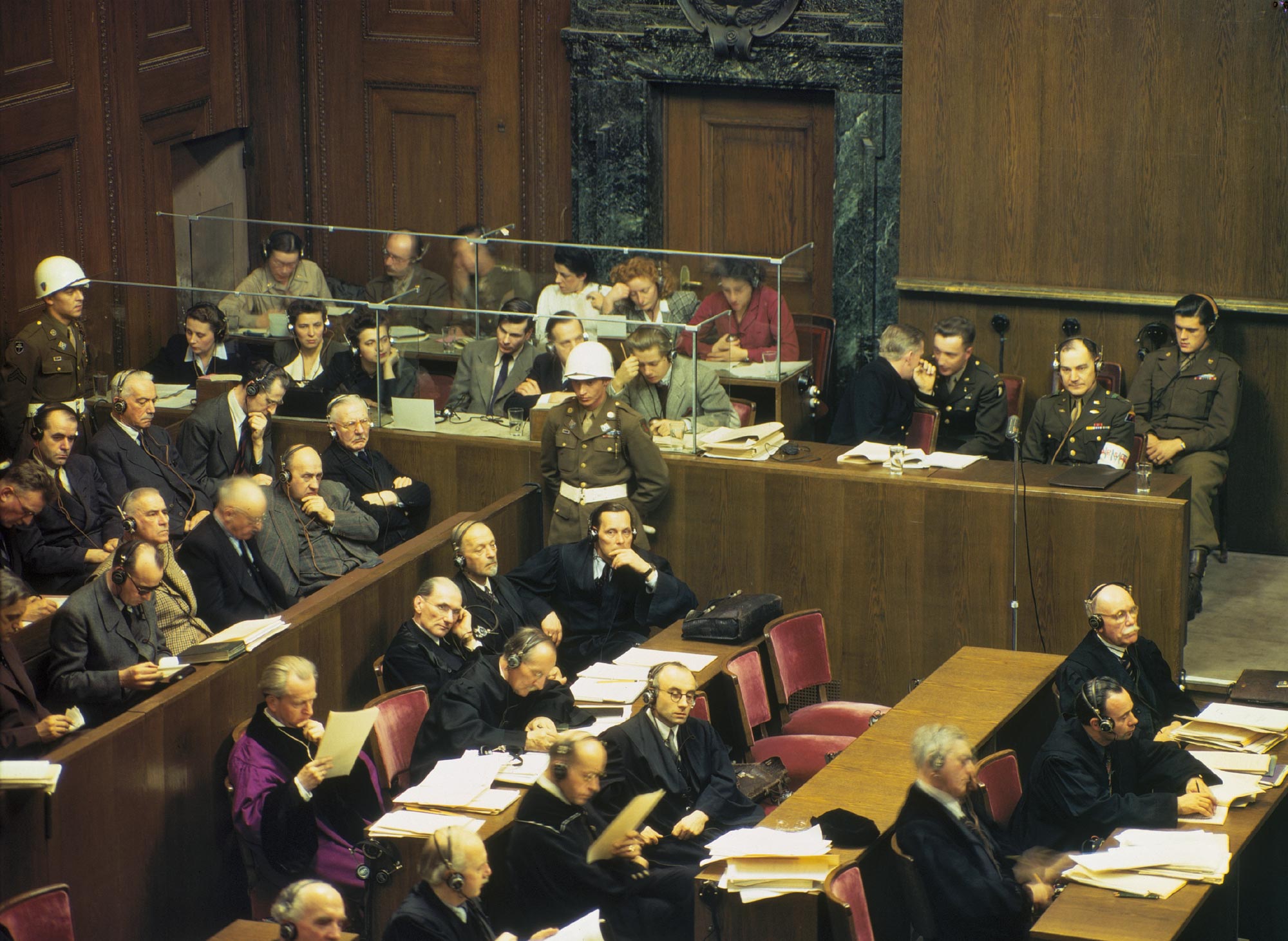
Vista de la sala del tribunal de Núremberg, con los intérpretes al fondo. Fotografía de Ray D'Addario, cortesía del Museo de la Ciudad de Núremberg. Tras las mamparas de cristal al fondo a la izquierda se traducen oralmente las deliberaciones del tribunal a cuatro idiomas. Las tres intérpretes de la cabina delantera izquierda interpretan al ruso; los de la cabina delantera derecha interpretan al inglés; los de atrás a la izquierda interpretan al alemán; y las tres de la cabina de atrás a la derecha interpretan al francés.
El comandante Steer, que aparece dando la espalda a la cámara a la derecha de las mamparas, supervisa a los intérpretes.
20th century Multilingualism in the European Union
19
Origins: a speech of war and peace
The process of construction that we now know as the European Union began after the Second World War, the bloodiest of conflicts that devastated the continent.
The historic declaration by Robert Schuman, the French Minister for Foreign Affairs, on 9 May 1950, marked the beginning of a new form of European cooperation.
Berlin, 1945. Bundesarchiv, B 145 Bild-P054320 / Weinrother, Carl / CC-BY-SA 3.0.
Europe Day is held on 9 May
In the 1950s, at the start of the process of European integration, the European Communities – precursors to the current EU – only had six Member States and four languages (German, French, Italian and Dutch). Even so early on, the newly created European institutions needed interpreters and translators in order to ensure the smooth running of meetings and effective written communication.
The multilingualism of the EU’s institutions is a fundamental principle enshrined in Council Regulation No 1 of 1958, which has been adapted as new countries have joined, with the four initial languages rising to the current 24.
Spain joined the European Communities in 1986, together with Portugal. Since 1 January of that year, Spanish and Portuguese have been official languages of the EU.
First page of Regulation No 1 (OJ 6.10.1958), determining the rules on languages to be used, as last adapted following Croatia’s accession in 2013.
Metro map of languages, from Translation in figures 2022. DGT publication.
The EU’s motto, ‘United in diversity’, also reflects the Union’s linguistic diversity. Translators and interpreters ensure multilingual communication and enable European legislation to be available in the languages of the Member States, with all versions having identical legal value.
First steps
In the early 1950s, the High Authority, which later became the European Commission, employed some 35 translators and revisers, translating into the four official languages. Translators were assisted by stenographers, who noted down the translations, and typists, who typed out the texts.
From the mid-60s until the beginning of the 90s, translators recorded their translations on a dictaphone, and typists then transferred the recording onto paper.
Interpreters initially worked in a consecutive fashion, i.e. the interpreter spoke once the speaker had finished. However, consecutive interpreting prolonged meetings considerably, and therefore simultaneous interpreting, where the interpreter listens and speaks at the same time, became increasingly common.
The Nuremberg trials from 1945 to 1946 are generally considered to have been a key moment in the history of interpreting. Simultaneous interpreting had begun almost twenty years earlier (see Panel 17), but at Nuremberg it established itself as the normal way of working.
View of the chamber of the Nuremberg court, with interpreters in the background. Photograph by Ray D’Addario, courtesy of the Museum of the City of Nuremberg. Behind the glass screens in the background on the left, the court’s proceedings are being translated orally into four languages. The three interpreters in the front left-hand booth are interpreting into Russian; those in the front right-hand booth are interpreting into English; those behind to the left are interpreting into German; and those in the rear right-hand booth are interpreting into French. Commander Steer, who appears with his back to the camera to the right of the screens, is supervising the interpreters.


