Siglos XIII a XV Iniciativas traductoras en Europa (II)
6
Otros centros de traducción en el Mediterráneo...
Hubo más centros de traducción entonces en la península ibérica y fuera de ella, entre los que ocupa sin duda un lugar destacado el Studium Arabicum et Hebraicum fundado por los dominicos en Murcia, importante centro cultural y científico ya durante la dominación árabe. En este ámbito se llevaron a cabo traducciones del árabe al latín de escritos de medicina e historia natural procedentes de la tradición greco-árabe, como las de Domingo Marroquino y Pedro Gallego.
Los dominicos fundaron estudios similares en Mallorca, Barcelona, Valencia, Xátiva, Murcia y Túnez; y Ramon Llull pretendió la creación de un Studium Arabicum, Tartaricum et Graecum en la Universidad de París. En realidad, detrás de estas fundaciones, impuestas por la exigencia de las relaciones internacionales, estaba la necesidad del aprendizaje de la lengua árabe por parte de religiosos que querían difundir su doctrina en tierras del norte de África y Oriente Próximo.

... y otros traductores
En el siglo XIII peninsular desempeñaron su labor otros muchos traductores, itinerantes o no, movidos por intereses académicos, políticos o religiosos. Destacada es la figura de Ramon Llull, que autotradujo muchas de sus obras en una llamativa actividad integradora de lenguas: latín, árabe, catalán. Y otros muchos, localizados especial aunque no exclusivamente en la Corona de Aragón, manejaron estas lenguas —a las que se añaden el aragonés, el castellano y el hebreo— para sus versiones de escritos de medicina, filosofía, moral, teología y religión.
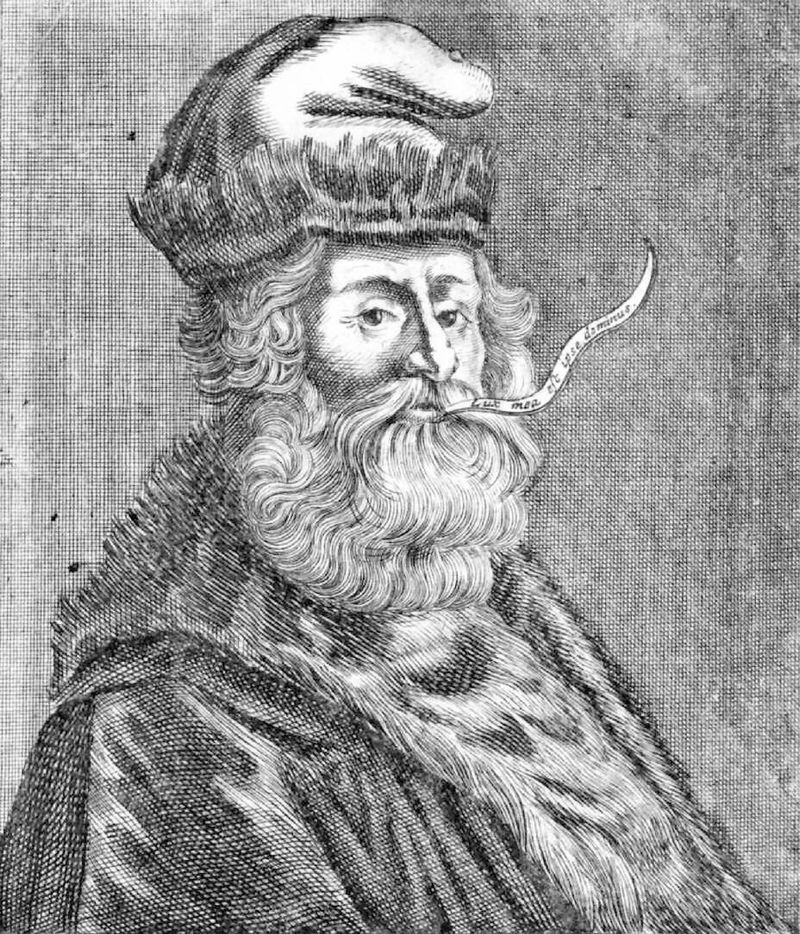
Ramon Llull (Colección Friderici Roth-Scholtzii Noriberg), [dominio público] vía Wikimedia Commons.
Federico II, Stupor mundi, y Manfredo de Sicilia
Otra importante empresa de traducción del siglo XIII fue la que impulsaron Federico II de Sicilia, emperador del Sacro Imperio Romano Germánico, y su hijo Manfredo. Pertenecían a la cultísima familia Hohenstaufen, que, por su presencia en el sur de Italia, había tenido un intenso contacto con la cultura árabe. Además de otras actividades literarias, impulsaron la realización de traducciones, de obras científico-técnicas del griego y del árabe al latín y al hebreo, encargadas a intelectuales como Bartolomé de Messina, Jacob Anatoli y Miguel Escoto.
Prima carnal de Federico II era precisamente la madre de Alfonso X el Sabio, Beatriz de Suabia, que se crió con él al perder a sus padres y antes de casarse con Fernando III. Ella murió cuando Alfonso tenía 14 años, pero es de suponer que influyó en la sensibilidad del futuro rey hacia los escritos todavía desconocidos en el mundo latino, hacia las lenguas y la poesía. Ciertamente hay significativas semejanzas entre las iniciativas culturales de ambos monarcas y hay que plantearse si Alfonso, que aspiraba a ser emperador como Federico, no lo estaría imitando también en esta faceta para conseguir sus propósitos.
La actividad impulsada en Sicilia por los Hohenstaufen continuó después con Carlos de Anjou en Nápoles y Salerno. En ese contexto tradujo Mosés de Palermo del árabe al latín la obra del hipiatra Hipócrates Indio, Liber de curationibus infirmitatum equorum, que sería puesta también en lengua vulgar en el mismo siglo XIII.
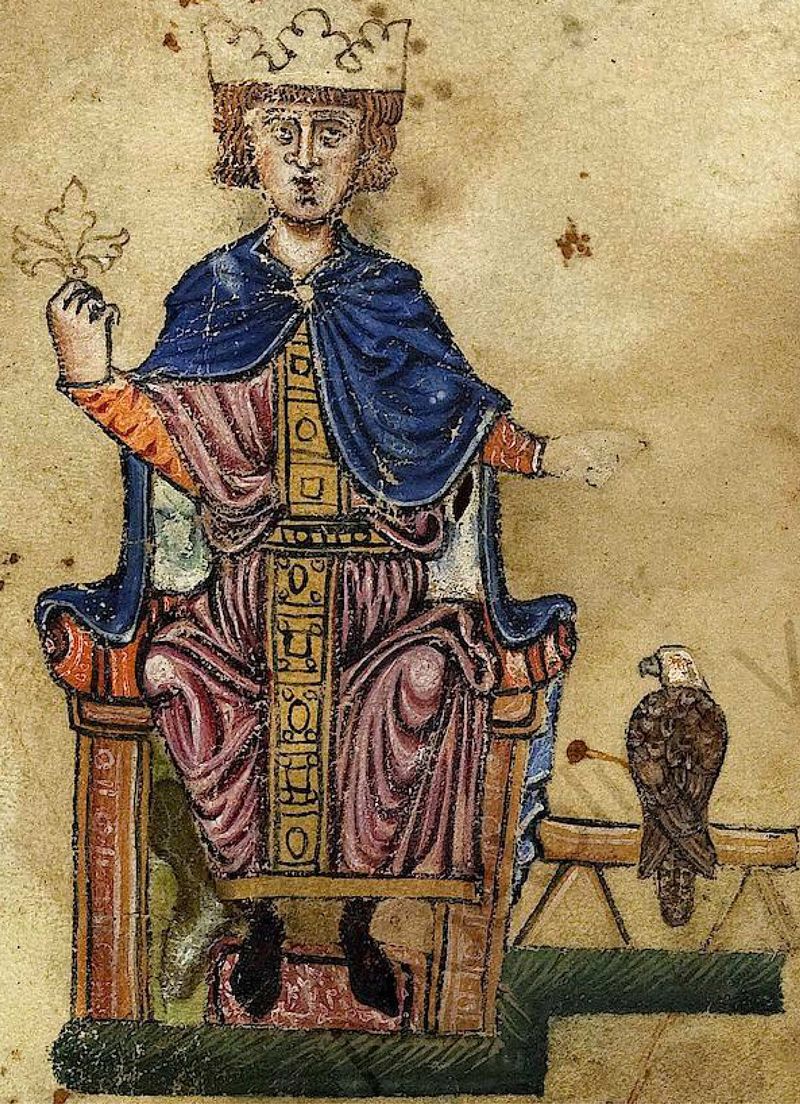
Federico II en su obra De arte venandi cum avibus (ms. Biblioteca Vaticana, Pal. lat. 1071, siglo XIII, ex. fol. 1).
13th to 15th centuries Translation initiatives in Europe (II)
6
Other translation centres in the Mediterranean...
There were more translation centres on the Iberian Peninsula and beyond it, notable of which was undoubtedly the Studium Arabicum et Hebraicum founded by the Dominicans in Murcia, which was already an important cultural and scientific centre during the period of Arab domination. Translations from Arabic into Latin of medical and natural history works originating from the Graeco-Arabic tradition were carried out there, such as those by Domingo Marroquino and Pedro Gallego.
The Dominicans founded similar centres of study in Mallorca, Barcelona, Valencia, Xátiva, Murcia and Tunis; and Ramon Llull sought to create a Studium Arabicum, Tartaricum et Graecum in the University of Paris. In reality, the founding of those centres of study, which were required for the purpose of international relations, reflected the need for religious figures who wished to spread their doctrine in North Africa and the Middle East to learn the Arabic language.
... and other translators
In the 13th century many other translators were working on the Peninsula, some itinerant and some not, whose interests were academic, political or religious. A prominent figure was Ramon Llull, whose translations of many of his own works were remarkably inclusive in terms of languages: Latin, Arabic and Catalan. And many others, located in particular, though not exclusively, within the Crown of Aragon, used those languages – as well as Aragonese, Castilian and Hebrew – for their versions of medical, philosophical, moral, theological and religious works.
Ramon Llull (Friderici Roth-Scholtzii Noriberg Collection), [public domain, via Wikimedia Commons].
Frederick II, Stupor mundi, and Manfred of Sicily
Another important translation enterprise in the 13th century was that of Frederick II of Sicily, Holy Roman Emperor, and his son Manfred. They belonged to the highly cultured Hohenstaufen family, who, due to their presence in southern Italy, had been in close contact with Arab culture. As well as other literary activities, they encouraged the production of translations of scientific and technical works from Greek and Arabic into Latin and Hebrew, commissioned from intellectuals such as Bartholomew of Messina, Jacob Anatoli and Michael Scot.
The first cousin of Frederick II was none other than the mother of Alfonso X the Wise, Beatrice of Swabia, who grew up with him, having lost her parents, and went on to marry Ferdinand III. She died when Alfonso was 14 years old, but it is reasonable to suppose that she influenced the future king’s sensitivity towards works that were still unknown in the Latin world, and towards languages and poetry. There are certainly significant similarities between the cultural initiatives of the two monarchs, and it is worth considering whether Alfonso, whose aspiration was to become Emperor like Frederick, was not also imitating him in that regard in order to achieve his aim.